MYP6 Unit 1 - What is science?
Content
- 6u1.1 - What is science?
- 6u1.2 - Evidence and the nature of science
- 6u1.3 - Classroom rules and science news
- 6u1.4 - Scientists and laboratory safety
- 6u1.5 - Observation and measurement stations
- 6u1.6 - Measuring length and scientific equipment
- 6u1.7 - Measurement circus and units
- 6u1.8 - The scientific method
- 6u1.9 - Variables and hypotheses
- 6u1.10 - Cooling water investigation
- 6u1.11 - Getting soaked investigation
Scheme of work
Introduction - What is science?
Science is a way of learning about the world using evidence. Scientists ask questions, make observations, collect measurements, test ideas and use results to improve explanations.
In this unit students are introduced to the habits and skills of science: curiosity, careful observation, accurate measurement, safe laboratory practice, fair testing, variables, hypotheses and simple conclusions based on evidence.
6u1.1 - What is science?
Science is often mistakenly thought of as a body of knowledge rather than the process that is carried out in order to obtain knowledge. In this unit we are going to see how science is used to investigate and discover information about the world around us using a process that we call the scientific method.
Scientific investigation sounds very complicated, but in fact we are all scientists from the very day we are born.
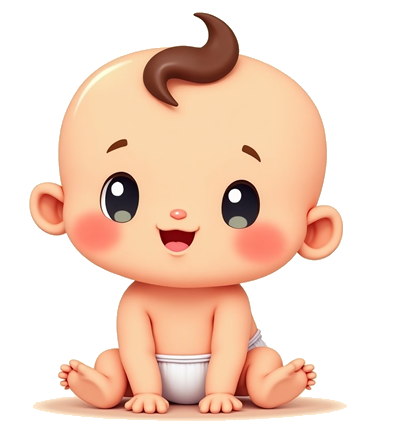
A baby investigates it's world by putting things into its mouth. A baby has an instinctive desire to eat, but it does not know whether something is edible or not.
So, when a baby finds something it does a test.
Scenario
Day 1 - the baby finds a small brown lump on the floor. He puts it in his mouth. It is chocolate and the baby receives a pleasant sensation. His brain registers the information:
The baby draws a conclusion - small brown lumps are nice and tasty.

Day 2 - the baby finds another small brown lump on the floor and makes a hypothesis: "this is a tasty treat, I can eat it".
But the small brown lump is dog poop from the family pet. The baby puts it in his mouth and receives an unpleasant surprise.

The investigation has revealed that not all small brown lumps are tasty!
The original hypothesis is not supported.
This is a scientific investigation. The baby performs a test and gathers information. The information is not all brown lumps are tasty.
Safety in the laboratory
Science is a process that is carried out to find out about the world around us. Scientists carry out investigations. They do this in laboratories (labs).
The first thing we must be aware of is how to work safely.
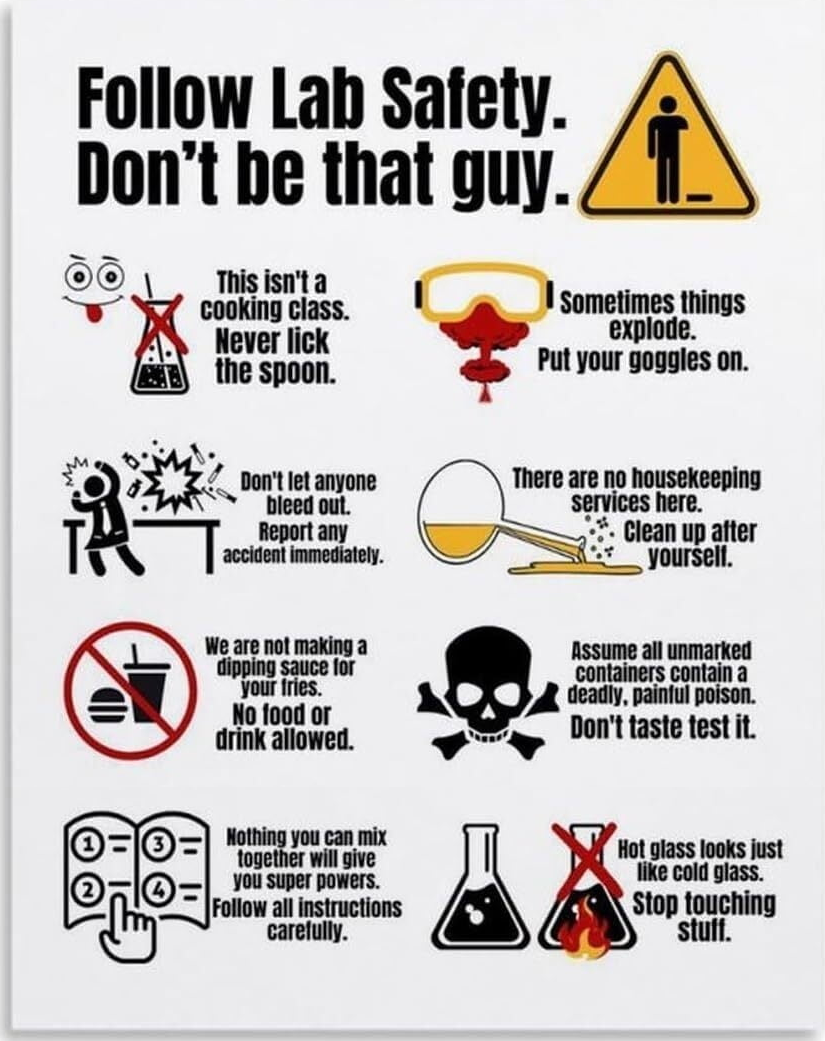
Accidents happen. That's why that is a word for them!
They are called accidents because we don't want them to happen. The best way to avoid accidents in the laboratory is to follow simple laboratory rules and protocol (ways of behaving).
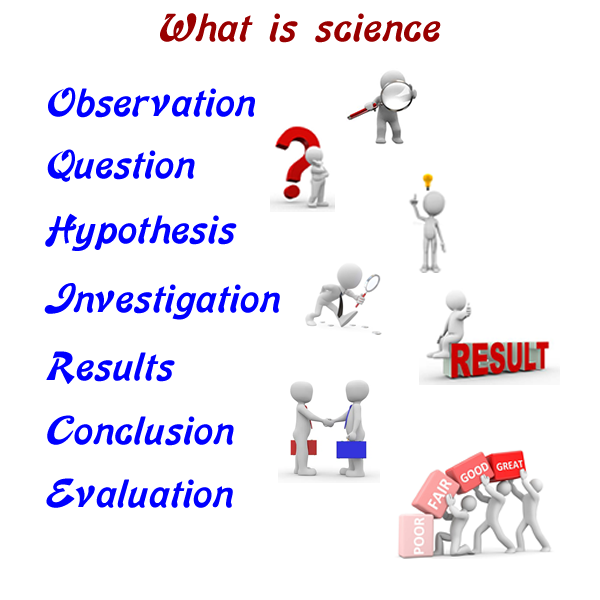
The observation
This means that we see or detect something that sparks our curiosity. It could be absolutely anything.
- Examples
- The sky is blue
- Sugar disappears when stirred in water
- Helium balloons float
- Light bulbs get hot
- Hot water cools down over a period of time
- Ice cream melts
The question
Question words are very familiar parts of the language:
- Question words
- Why?
- Where?
- How?
- How many?
- When?
- How far?
The scientist (we are all scientists!) comes up with a specific question about his/her observation. And considers an investigation to get data which may help answer the question.
The investigation

He/she may decide on a possible outcome of the investigation, in which case we say that he/she has made a hypothesis.
The hypothesis

This is not always an essential part of the scientific method, but if it is stated then it usually takes the following form:
I think that X will happen because of Y
In this case 'X' is the outcome, or findings, of the investigation and 'Y' is the scientific reason for thinking that.
The investigation MUST be planned as a fair test - but what does this mean?
Students begin by considering what science is and how it is different from other areas of knowledge. Science is presented as evidence-based knowledge that changes when new evidence becomes available.
Three main areas
- How does science work?
- How is science different from other areas of knowledge?
- Why is evidence important in science?
Summary
- Science uses evidence to build explanations about the natural world.
- Scientific ideas can change when new evidence is discovered.
Check your understanding
- What makes an explanation scientific?
- Why is evidence important in science?
- How can scientific ideas change over time?
6u1.2 - A fair test?
A fair test is when we are sure that only the factor under study can influence the final results.
Imagine that we want to find out which type of running shoe performs better, Pike or Adidad.
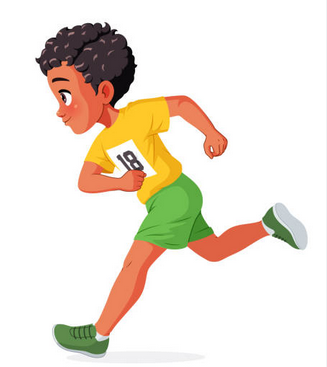
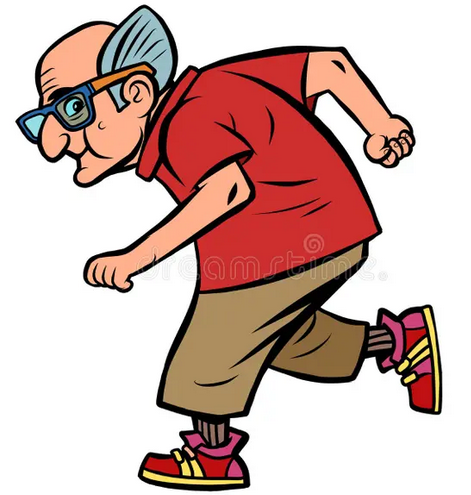
Why can't we time both of the athletes in the picture above, when they race over 100m to check to see which shoe performs better?
Is the test fair?
We have to carefully consider all of the possible things that could be changed in the test, such as:
- Things that could be changed
- The type of shoe
- The runner
- The runner's clothes
- The distance run
- The time taken
- The time of day
- The weather
We must change only the one thing that we are investigating to decide which shoe performs better.
We call any factor that could affect the outcome of an investigation a variable - it is something that could be changed. Some variables can have an influence on the outcome of an experiment, while others are rather trivial. However, if we don't know that we have to assume that anything that could be changed MUST be kept the same.
6u1.3 - Evidence and the nature of science
Students explore how new evidence can change explanations. The tangram activity provides a simple model for scientific thinking: students make an explanation from the available pieces, then revise it when an extra piece is added.
Activity - Tangram evidence challenge
Procedure
- Students use a set of tangram pieces to make a shape or explanation.
- An additional x piece is then introduced.
- Students reconsider their original explanation and decide whether it must be changed.
Discussion
- How did the new piece change your thinking?
- Was the first answer wrong, or was it based on incomplete evidence?
- How is this similar to new scientific research?
Summary
- Scientific explanations are based on the evidence available at the time.
- New evidence can improve, replace or refine existing explanations.
Check your understanding
- Why do scientists sometimes change their explanations?
- What is meant by evidence-based knowledge?
- How did the tangram activity model the nature of science?
6u1.4 - Classroom rules and science news
Students establish classroom expectations for science lessons and begin to identify science in real-world contexts by reading a science news article for young people.
Classroom rules
Students help to establish the rules needed for a safe, respectful and productive science classroom.
Activity - Science news for kids
- Read a short science news article.
- Identify the science that was carried out.
- Find the new evidence or discovery described in the article.
- Explain how the article links to the idea that science is evidence based.
Summary
- Science lessons require agreed routines and safe behaviour.
- Science news often reports new evidence, new methods or new explanations.
Check your understanding
- What makes a good classroom rule for science?
- What new evidence was described in the article?
- How was the article an example of science in action?
6u1.5 - Scientists and laboratory safety
Students reflect on how they picture scientists and consider the importance of open-mindedness in science. They are then introduced to laboratory safety using a lab disaster image.
Scientist profiles
Students consider different scientist profiles and challenge simple stereotypes about what scientists look like or how scientists work.
Activity - Lab disaster image
- Look carefully at the lab disaster image.
- Identify unsafe behaviour or unsafe conditions.
- Suggest safer alternatives for each problem.
- Begin a mini-safety poster showing important laboratory safety rules.
Summary
- Scientists need curiosity, creativity, evidence and open-mindedness.
- Safe behaviour protects students, teachers and equipment.
Check your understanding
- Why is open-mindedness useful in science?
- Name three important laboratory safety rules.
- Why should safety rules be followed even during simple activities?
6u1.6 - Observation and measurement stations
Students rotate around six stations designed to develop careful observation and simple measurement skills. Possible stations include candle burning, stick bugs, temperature of tap water and other teacher-selected examples.
Activity - Observation and measurement stations
Procedure
- Rotate around six practical stations.
- Record observations using clear, precise language.
- Record measurements using numbers and units where appropriate.
- Discuss which stations involved observation and which involved measurement.
Observation vs measurement
An observation is something noticed using the senses or suitable instruments. A measurement is a type of observation that includes a number and a unit.
Observation and measurement
The water feels warm is an observation.
The water temperature is 31 °C is a measurement.
Summary
- Observations describe what is noticed.
- Measurements include numbers and units.
Check your understanding
- What is the difference between an observation and a measurement?
- Give one qualitative observation from a station.
- Give one quantitative measurement from a station.
6u1.7 - Measuring length and scientific equipment
Students practise measuring length using hand tracings or shoe tracings. They also begin an equipment inventory in the back of their yellow book, recording the name, sketch and function of scientific apparatus.
Activity - Measuring height from tracings
- Make hand tracings or shoe tracings.
- Measure the length of the tracing accurately.
- Compare measurements with height data.
- Discuss whether body measurements can be used to make predictions.
Scientific equipment inventory
Students start a personal equipment inventory. For each piece of apparatus they should record the name, make a sketch and describe the function.
Summary
- Accurate measurements need suitable equipment and correct units.
- Knowing the names and functions of apparatus helps students work more independently.
Check your understanding
- Why should measurements include units?
- What makes a scientific sketch useful?
- Why is it important to know the function of apparatus?
6u1.8 - Measurement circus and units
Students complete a measurement circus with six stations. The focus is the importance of units, careful recording and choosing suitable equipment.
Activity - Measurement circus
- Complete six different measurement stations.
- Record each measurement in a table.
- Include the correct unit for every value.
- Add new apparatus to the science equipment inventory.
Measurement table
Students use a simple table to organise results clearly. Each column should have a heading and a unit where appropriate.
Measurement table headings
A clear heading might be: length of shoe tracing / cm.
This shows both what was measured and the unit used.
Summary
- A number without a unit is usually not a useful scientific measurement.
- Tables help scientists record results clearly and consistently.
Check your understanding
- Why are units important?
- What information should be included in a table heading?
- Why should scientists choose suitable measuring equipment?
6u1.9 - The scientific method
Students brainstorm the steps of the scientific method and connect these steps to a hypothetical experiment. The example used is growing plants to see whether adding a substance to the irrigation medium affects a feature of plant growth.
The steps of scientific method
- Ask a question.
- Make observations or do background research.
- Write a hypothesis.
- Plan a fair test.
- Collect results.
- Analyse the results.
- Make a conclusion based on evidence.
- Evaluate the method and suggest improvements.
Plant growth example
A student could investigate whether adding a fertiliser to the irrigation water affects plant height.
The method must make clear what is changed, what is measured and what is kept the same.
Summary
- The scientific method gives structure to an investigation.
- A good experiment must be planned so that the evidence can answer the question.
Check your understanding
- What is the purpose of a hypothesis?
- Why should scientists collect results carefully?
- Why should a conclusion be based on evidence?
6u1.10 - Variables and hypotheses
Students review the steps of the scientific method and use demonstrations and short investigations to focus on experimental variables. Sounding tubes can be used as a demonstration, followed by pendulum investigations.
Experimental variables
- The independent variable is the factor that is deliberately changed.
- The dependent variable is the factor that is measured or observed.
- Controlled variables are the factors kept the same to make the test fair.
Activity - Pendulum variables
- Investigate how the length of a pendulum affects swing rate.
- Investigate how the mass of the bob affects swing rate.
- Identify the independent, dependent and controlled variables.
- Use the investigation to practise writing hypotheses.
Hypothesis writing
A hypothesis is a testable prediction. It should link the independent variable to the dependent variable.
Hypothesis example
If the length of the pendulum is increased, then the time for one swing will increase.
This is testable because the length can be changed and the swing time can be measured.
Summary
- Variables help scientists design fair tests.
- A hypothesis should be clear, testable and linked to the variables.
Check your understanding
- What is an independent variable?
- What is a dependent variable?
- Write a hypothesis for a pendulum investigation.
6u1.11 - Cooling water investigation
Students carry out a formative Criterion C investigation into the cooling of water. They measure how long it takes different volumes of hot water to cool by 10 °C.
Activity - Cooling water experiment
Investigation focus
- Students measure how long it takes for various volumes of hot water to cool by 10 °C.
- The investigation is used to practise careful measurement, recording results and identifying variables.
- Students should complete a results table and make a simple conclusion from the evidence.
Variables
- Independent variable: volume of hot water.
- Dependent variable: time taken to cool by 10 °C.
- Controlled variables: starting temperature, container type, room conditions and thermometer position.
Summary
- Cooling investigations require careful temperature and time measurements.
- Controlled variables help make the investigation fair.
Check your understanding
- What was the independent variable in the cooling water experiment?
- Why should the same type of container be used each time?
- How could you make the results more reliable?
6u1.12 - Getting soaked investigation
Students complete a formative Criterion B investigation. They plan and carry out an experiment to test the efficiency of different tissues or papers in absorbing water.
Activity - Getting soaked
Investigation task
- Plan an experiment to test how efficiently different tissues absorb water.
- Use at least four different types of paper or tissue.
- Choose a suitable method for collecting data.
- Record results clearly and use them to support a conclusion.
Possible data collection methods
- Measure the mass of water absorbed.
- Measure the volume of water remaining after absorption.
- Measure the area of water spread on the paper.
- Compare absorption time for a fixed volume of water.
More variables practice
Students complete further practice identifying independent, dependent and controlled variables using a worksheet or short classroom examples.
Summary
- A good investigation plan explains what will be changed, measured and kept the same.
- Different methods can be valid if they collect useful evidence for the research question.
Check your understanding
- What makes a test fair?
- Why should at least four different tissues be tested?
- Suggest one controlled variable for the Getting soaked investigation.